![[personal profile]](https://www.dreamwidth.org/img/silk/identity/user.png) captainsblog
captainsblogOkay, Sunday wasn’t THAT bad. I was still a little sniffly in the final days of my traditional midwinter bug, but this was the first weekend in several that we hadn't done anything together outside the house. I did make it to my Saturday writing group, but mainly sat there like a slug without any submission of my own, and instead of the sportsball thing Sunday night we watched a very beautifully done but deeply disturbing film from a Director we’ve seen more uplifting things from in recent past.
I tried getting into the series from last year about Boba Fett (which Siri just translated as Bubba Fat). I think I’ll take my chances figuring out the backstory when Mandalorian comes back, because it’s just as confusing starting with episode one of that thing; I don’t understand what’s going on and why.
And what, you ask, will I be doing with all that free time not spent on Tattooine or wherever?
Yes, resistance is futile. I've started watching The Last of Us. I knocked off the pilot last night and will try to get caught up over the next couple of weeks. I'd been seeing so many things about it, mostly good, then I’m going to absorb the whole thing by osmosis even if I don’t watch it, so I may as well enjoy it as I go. Nick Offerman, we love from so many things, has arrived in it, and I’m told there’s a song that will absolutely melt me. So fine, y’all win.
Not-especially spoilery thoughts about the first 90 minutes of it:
I'm glad, for one thing, that the rest of these aren't 90 minutes. Apparently what became Episode 1 was originally intended as a two-parter, mostly set in the pre-present-day times with only a brief hint at the end of what lay ahead for Just Joel. They didn't want to end the audience's first look at the series on what happened at the end of events in 2003 without a more extensive and hopeful look at where things are "now."
Their "now" is not our "now," fortunately. At least not yet; we've certainly had plenty of crazy shit happen to us in 2023 already, but we're not in a dystopic world under the rule of a military junta with zombie-creating organisms working away at us.
Nah, we just are having earthquakes, Chinese spy balloons and recurrences of COVID.
I made it through those first 90 minutes despite finding dystopic dramas really hard to take. This one reminded me a lot more of Handmaid's Tale than it did of, say, Dead Don't Die. It has its moments of humor, but they're mostly snarky moments coming from Joel's interactions with his own kid and then, briefly, with Ellie. Her character is clearly the most compelling in the entire series, and I wonder if the Stranger Things crew has some beef with them playing on Eleven's nickname for this show's character. (Likewise wonder over whether the Firefly people have any issue with the name of their rebels being "borrowed.")
There's plenty of original creativity beyond those nitpicks, though: making car batteries the source of scarcity is brilliant, as is the codebook.
I'm not committing to being all-in yet. I'll definitely stay in until Nick shows up in (I'm told) the third one, and two a week from here on would get me caught up by time the seventh shows up at the end of this month.
Now that I've given in on this series, you have to indulge me with something else I discovered over the weekend, a long lost radio series, finally found!
Those over-the-air signals you watch (or used to) on your televisions before cable and streaming? Or still listen to, maybe, on a car radio? We own those airwaves. Since the development of radio a century ago, the government has regulated them, but largely taken the rights to use them and given them away for free to broadcasters who, for decades, have made gagillions of dollars and built empires of sight and sound using them. For this generous gift, all the licensee had to do was to promise to use those airwaves "in the public interest." Somehow, I don't think Charlie Sheen and Rush Limbaugh were what the original drafters of the Communications Act or regulations had in mind, yet that's where we wound up.
When I was growing up, the efforts were at least a little better. For one thing, there was a thing called the Fairness Doctrine, and another thing called the Equal Time Rule. They were often mixed up, but had different derivations (administrative regulation versus enacted statute), different targets (broadcast discussions versus political advertisements) and, most importantly, current statuses. The Equal Time Rule, requiring broadcasters to provide "equal time" to any candidate for public office if they offer any airtime to any of them, remains on the books, if riddled with exceptions. The Fairness Doctrine, which required broadcasters to present both sides of controversial issues, was abolished during the Reagan era, leading to the craziness that infects those airwaves like a fungus to this very day.
Beyond those, though, broadcasters had other ways to prove they were "serving the public interest." There were "public affairs" programs dedicated to worthy causes or discussions of important topics. TV and radio stations would typically bury these in the middle of the night or the start or end of their broadcast days. Two I remember: "Sunrise Semester," a long-running adult educational program originating out of WCBS-TV where I lived; and "Mental Health Matters," a weekly radio program on the "beautiful music" station my father would have on when I was up stupid early on Sunday mornings to deliver newspapers in high school.
The only place these "public interest" minutes worked their way into the waking world of popular radio? The news. Even rock'n'roll stations would still cut away from the Top Forty for a few minutes here and there and hand over those airwaves to a syndicated network feed of national news, or a local newsman (almost always of that gender back then) who would usually just read wire copy off an Associated Press teletype machine. The exception was the occasional station that really built it up:
Yeah, those were mostly fictional. DJs hated the interruption of their formats as much as Johnny did in that clip, and program directors were afraid of losing their audience to another push-button on the car radio or a flip of the dial.
So by the time I got to college, somebody had found a need and filled it- with helium:

I think I first heard these on Cornell's student-run radio station WVBR. Back on Long Island vacations, the morning guy on WLIR would introduce them every morning at 8:30 after Idi Amin did the time check. Off to Buffalo? Along came the Blimp on Z98, with one of their own DJs contributing a voice- as did LIR afternoon guy Ben Manilla and Tom Powell, another Long Island radio voice I knew.
Voices to what? To a more-or-less timely mix of actual news, quotes from the people making or covering it, and clips from format-fitting songs or comedy pieces. I heard a lot of Firesign Theater on these segments, a little Cheech, a little Chong, maybe some Monty Python. They were the social media clickbait of their time: just a little actual information to pique your curiosity and keep you listening through the next commercial until the regularly scheduled program came back on.
None of the Rochester stations I listened to carried the broadcasts from the Blimp, and those brief moments faded into memory- but, like so many 1960s phone numbers and 1970s Mets batting averages, never completely left my brain. Every now and then, something would trigger a recollection of a story, a voice or a comedy bit I'd heard, but the Internet had very little if anything to bring me back.... until something popped up Saturday morning and I googled it to find that website, that graphic and a treasure trove put up by radio legend Ben Manilla himself a couple of years ago.
A link to their Youtube channel with dozens of the actual Blimp broadcasts from the late 70s.
An interview with one of the founding voices of the program, Rich Barna, who oh-so-casually mentions that his co-founder, a guy named Mitch Kapor, left early on to study from a Maharishi in India and somehow returned to essentially invent the computer spreadsheet format that I use every freakin' day.
And pictures! Of some famous people who may, or may not, have been associated with the Blimps:
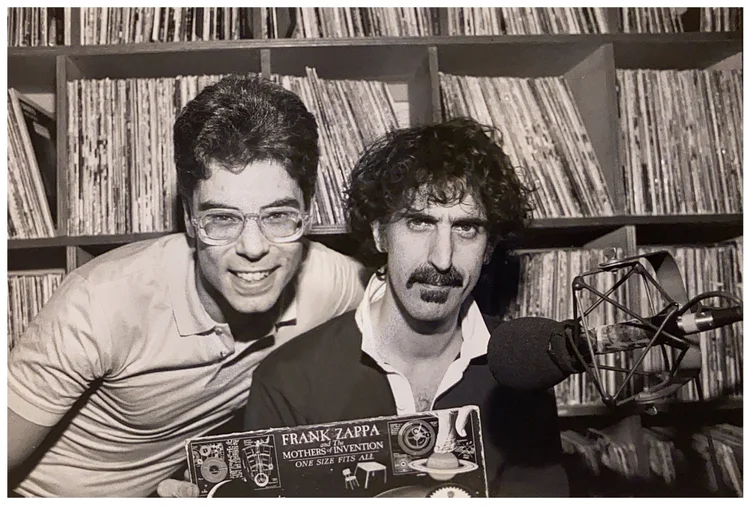
Frank Zappa (on Ben's left)
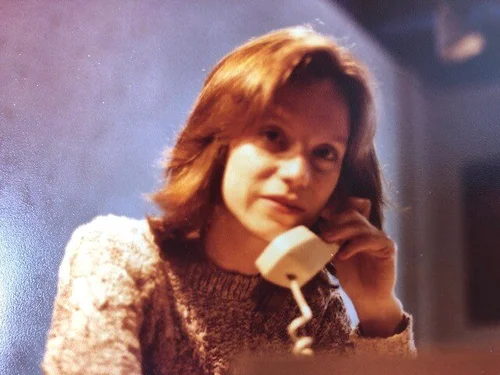
-and longtime NPR Morning Edition host Renee Montagne.
Why did the Blimp crash? Again, the founder's interview, which mentions another president's decision to change the face of broadcasting into the beast it now is:
What happened was the requirements for news and public affairs programming were removed in the 90’s because of the Clinton Administration’s deregulation of the broadcast industry. The effect was that the stations no longer were required to do news, so they were not that excited about buying outside news services like The Blimp. We migrated at that point, or pivoted, using today's words, into straight comedy. We developed new shows on audio and music. But the main one was straight comedy, which was very successful. That was fun, but as to how it all ended? It was a personal decision.
Sadly, this venture doesn't look like it's been kept updated since 2021, but it'll take years for me to get through what's here. And maybe it's just as well they didn't make it much past the 80s: I hear the music back then was trouble;)
no subject
Date: 2023-02-16 02:48 am (UTC)no subject
Date: 2023-02-16 04:08 am (UTC)